If you're exploring community solar for your commercial property portfolio, you may be wondering whether you or your tenants can subscribe to the energy generated by a rooftop solar installation—and what direct benefits your building receives.
The short answer: Yes, subscription opportunities often exist, but they're optional. The primary benefit to your building comes from predictable lease revenue, not energy consumption.
Let's break down how community solar subscriptions work, who benefits, and what this means for your properties.
Understanding rooftop leasing vs. energy subscriptions
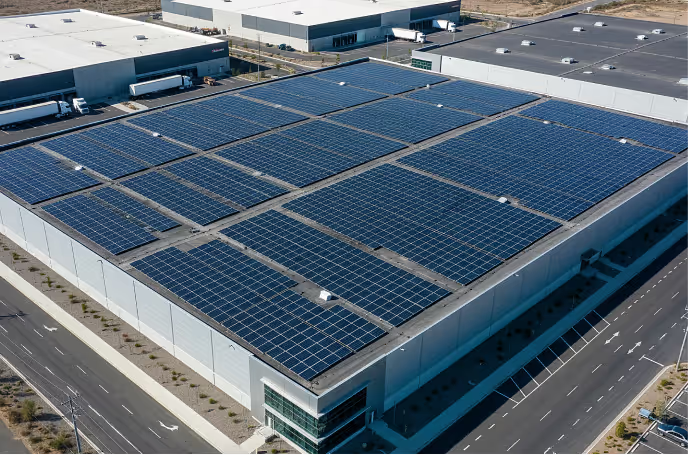
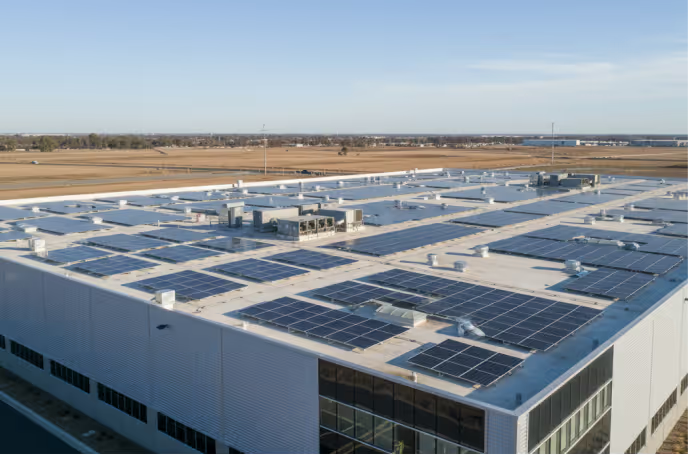
When you participate in a community solar program as a building owner, you're engaging in rooftop leasing—not installing solar for your own energy consumption.
Here's the distinction:
Rooftop leasing means you lease your roof space to a solar developer who builds and operates a community solar system. The energy flows to the grid (front-of-the-meter), and you receive annual lease payments over 15–25 years. This is zero CapEx revenue that increases your net operating income (NOI) without operational complexity.
Energy subscriptions are a separate, optional opportunity where building occupants—either you (the owner) or your tenants—can subscribe to receive credits on their utility bills from the community solar project.
The key point: Your building earns lease revenue regardless of whether anyone subscribes to the energy. The lease payment is based on the roof space and system size, not on who consumes the power.
Can building owners subscribe?
Yes, in many cases building owners can subscribe what's called "house loads" or common area electricity to a community solar project hosted on their own roof.
This creates dual benefits:
- Lease revenue from renting your roof space
- Energy bill savings from subscribing to the solar credits
However, there's an important economic consideration: In some markets, subscribing commercial loads can actually reduce the lease rate developers are willing to pay. This is because developers often maximize project economics by prioritizing residential subscribers, who typically receive higher credit rates under community solar programs.
Your solar advisor can help you model both scenarios—lease revenue alone versus lease revenue plus subscription savings—to determine which approach maximizes value for your specific properties.
Can tenants subscribe?
In many cases, tenants may have the option to subscribe to energy from a community solar project hosted on their building's roof, though it's not required. The opportunity for tenant subscription depends on the market and specific project.
This creates a compelling value proposition:
- For you (the owner): Lease revenue without tenant involvement required
- For tenants: Optional bill savings, typically 10–35% depending on the market
The beauty of this model is that, so long as you legally hold the roof rights for your property, tenant participation is not required for you to receive your lease payments. The developer manages subscriber recruitment and billing. Your tenants can opt in or out based on their preferences, and it doesn't affect your revenue stream.
Market-specific subscription benefits
Subscription value varies significantly by state and utility. For example:
Illinois (ComEd and Ameren territories): The Illinois Shines program offers unusually attractive commercial subscription rates—typically a 5% flat discount on all utility charges. Credits are applied directly to bills with no changes to existing utility billing setup.
New Jersey, Maryland, Massachusetts, New York: These markets have robust community solar programs with varying subscription discount rates, typically ranging from 10–20% for commercial subscribers, with higher rates often reserved for residential and low-to-moderate-income (LMI) participants.
What are the direct benefits to my building?
Let's be clear about the primary value proposition: lease revenue.
When you host a community solar installation, you receive:
Predictable cash flows: Annual lease payments ranging from tens to hundreds of thousands of dollars per property, depending on roof size, location, and market conditions. In a recent Lumen analysis, industrial properties averaged $449,000 per year in lease revenue.
Zero CapEx investment: The developer funds all design, installation, operations, and maintenance. You collect checks without capital outlay.
Long-term contracts: Lease terms typically span 15–25 years, providing stable ancillary income over the long term.
ESG and GRESB benefits: Hosting community solar enhances your property's sustainability profile, supporting corporate decarbonization goals and improving GRESB scores—without the complexity of behind-the-meter systems.
Optional energy savings: If you or your tenants choose to subscribe, you can layer utility bill savings on top of your lease revenue (though economics vary by market).
The hands-off advantage: no tenant involvement required
One of the most attractive aspects of community solar for commercial property owners is that tenants do not need to be involved for you to benefit.
This matters especially for:
- Triple-net (NNN) leases where tenants control their utility accounts
- Multi-tenant properties where coordinating energy decisions is complex
- Properties with tenant turnover where long-term energy contracts create friction
With rooftop leasing, the solar developer takes on all subscriber recruitment, billing coordination, and operational responsibilities. You simply lease the space and collect revenue. Tenants can choose to participate in energy subscriptions if they wish, but it's not a prerequisite for your income stream.
Understanding the subscription process
In some markets, you may lease your rooftop and subscribe your electricity load to the community solar program. If you or your tenants decide to explore subscription opportunities, here's how it typically works:
Enrollment: Subscribers sign up directly with the solar developer or through a program administrator.
Bill credits: Subscribers receive credits on their utility bills based on their share of the solar project's energy production.
Guaranteed savings: Most programs guarantee a minimum discount (often 10%) compared to standard utility rates.
Consolidated billing: In mature markets, utility consolidated billing streamlines the process—subscribers receive a single bill that combines regular utility charges and community solar credits.
Flexible terms: Commercial subscription agreements typically range from 3–5 years, though terms can sometimes be negotiated.
Making the decision: is rooftop leasing right for your portfolio?
Community solar rooftop leasing makes the most sense when:
Geography aligns: Your properties are in states with robust community solar programs (Maryland, New Jersey, Massachusetts, Illinois, New York, D.C.)
Roof characteristics fit: Large, unobstructed roofs (typically supporting 1+ MW systems) in good condition with sufficient remaining useful life.
Tenant complexity exists: Properties with NNN leases, multi-tenant configurations, or situations where behind-the-meter solar coordination would be difficult.
NOI improvement is a priority: You're seeking additional revenue streams without CapEx investment or operational burden.
Timelines are long: Community solar development can take 18–36 months from lease signing to system operation. Properties with stable, long-term hold strategies are ideal candidates.
How Lumen Energy helps building owners navigate community solar
As the modern solar broker, Lumen Energy sits on your side of the table throughout the rooftop leasing process:
Portfolio screening: We identify which properties in your portfolio are strong candidates for community solar based on location, roof characteristics, and market conditions.
Competitive bidding: We run transparent bid processes with vetted developers, typically revealing 2–5x variation in lease rate offers for the same property.
Subscription analysis: We help you model whether house load or tenant subscriptions enhance your overall returns, or whether lease revenue alone maximizes value.
White-glove service: From initial analysis through lease execution and project development, your Lumen advisor ensures your interests are protected at every step.
Bottom line: lease revenue first, subscriptions optional
When evaluating community solar for your commercial properties, remember this hierarchy:
Primary benefit: Predictable lease revenue over 15–25 years, zero CapEx, no tenant involvement required.
Secondary opportunity: Optional energy subscriptions for you or your tenants that can provide additional utility bill savings, depending on market economics.
The decision framework: Model your lease revenue first. Then explore whether subscriptions enhance or reduce that value based on your specific market and property characteristics.
Community solar rooftop leasing offers institutional real estate owners a rare combination: new revenue, simplified execution, and ESG progress—without operational complexity.
Ready to explore rooftop leasing for your portfolio?
Lumen Energy provides complimentary portfolio analysis to help you identify which properties are strong candidates for community solar. Our proprietary Lux Engine delivers investment-grade financial analysis in hours, not weeks.
Contact us to request a custom assessment of your portfolio's rooftop leasing potential.