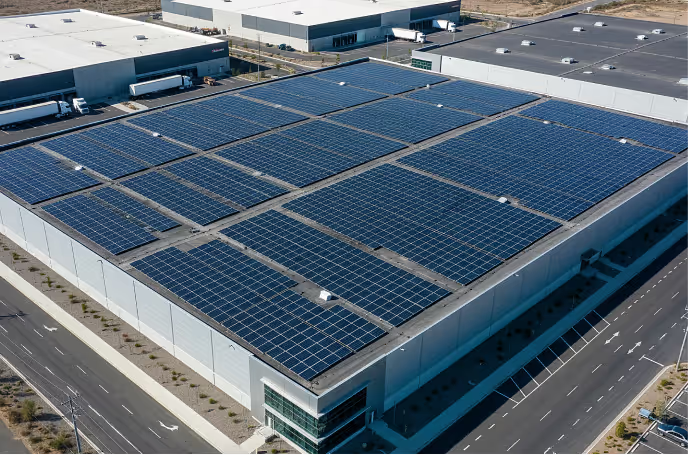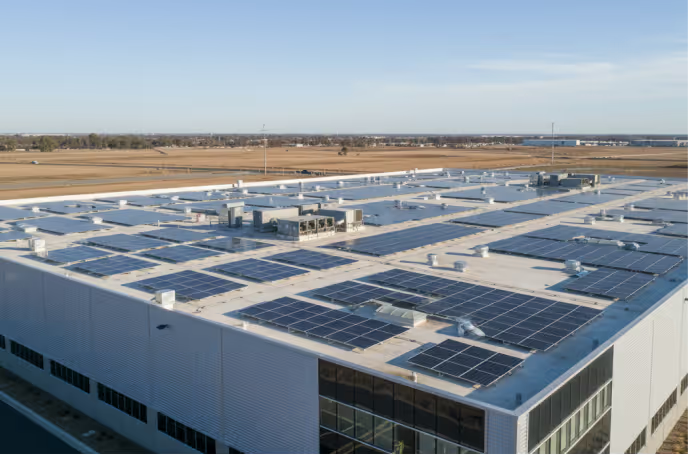
Making the right solar decision for your commercial real estate portfolio starts with understanding two distinct approaches: Behind-the-Meter solar and Front-of-the-Meter solar. While both generate clean energy, the way in which economic value is captured differs and ultimately serves different strategic goals. Below is a practical breakdown for asset managers deciding which approach fits their portfolio.
Understanding the core difference
Behind-the-meter (BTM) solar
Behind-the-meter solar is what most people picture when they think of rooftop solar. Panels are installed on your building and the power flows directly back “behind” the building’s meter, offsetting how much energy you would otherwise buy from the utility.
In simple terms, your building is producing and consuming its own power.
Key characteristics:
- Energy flows “behind” the on-site meter
- Savings benefit whoever pays the electric bill
Front-of-the-meter (FTM) solar
Front-of-the-meter solar installations send all the energy produced back into the local grid, meaning it isn’t connected to your building’s meter. A solar developer leases your unused rooftop space (and/or parking lot), builds and operates the system and sells the energy either to local community subscribers (through community solar) or the utility (through feed-in-tariffs).
In simple terms, you are monetizing unused space rather than reducing the amount of electricity you need to import.
Key characteristics:
- Energy flows back to the grid
- You earn lease revenue in exchange for hosting the system
- No direct impact on your utility bills
The financial models: Utility bill savings vs. lease revenue
The economic case for each approach differs significantly.
BTM economics: Lower operating costs
Behind-the-meter solar creates value by reducing electricity costs. If you pay the power bills, those savings flow straight into your NOI over time. If your tenants pay the power bills, the savings flow to their NOI, but you can recoup through billing or leasing changes.
Best fit when:
- You (the owner) pay the building's electricity costs
- Your property has high daytime energy consumption
- Utility rates are high and rising
- Reducing operating expenses is a priority
Less compelling when:
- Tenants pay their own utility bills
- The building has low daytime energy use
- Utility rates are inexpensive
FTM economics: New revenue streams
Leasing your roof to host a front-of-the-meter solar system creates a new income stream, regardless of energy consumption on-site. This is zero CapEx revenue that flows directly to your bottom line, regardless of your building's energy consumption.
Best fit when:
- The property is in market with FTM incentives (community solar programs or feed-in-tariffs)
- You want predictable cash flows without operational complexity
- Tenants control their own utility accounts
Less compelling when:
- Your state lacks robust community solar policies or feed-in-tariffs
- Developer interest in your market is limited
- Lease rates don't meet your return thresholds
Decision framework: Four questions to ask
1. Is there strong local policy enabling front-of-the-meter solar?
Community solar and feed-in-tariff programs are enabled by state legislation and utility rulings. As a result, economics vary dramatically by geography. Some states like New Jersey, Illinois, and Maryland have robust programs that drive strong developer demand and competitive lease rates. Other states have limited or no community solar frameworks.
Behind-the-meter solar, by contrast, is allowed nearly everywhere, though economics improve in markets with higher utility rates and strong net metering policies.
2. How much risk are you willing to take on?
BTM solar carries more uncertainty because returns depend on future electricity prices, stable on-site energy use, and system performance over time. You are effectively betting that utility rates will continue to rise and that your building’s load profile will remain aligned with the system’s production. If energy usage declines due to tenant turnover, operational shifts, or efficiency upgrades, the value of avoided utility costs can diminish.
Rooftop leases for FTM sit at the opposite end of the risk spectrum, where new income is a contractually defined lease payment independent of utility rates, building usage, or system performance. In that structure, the developer assumes pricing and operational risk, while you benefit from predictable, low-volatility cash flow.
Neither approach is inherently better, but they serve different risk appetites. BTM solar can offer meaningful upside, particularly in high-rate markets, but that upside comes with variability. FTM rooftop leasing trades potential upside for predictability, which can be attractive for portfolios prioritizing stable cash flow and downside protection.
3. How much complexity are you willing to manage?
BTM solar requires more operational coordination, particularly in multi-tenant buildings.NOI depends on how the system performs and how well production aligns with on-site usage over time. As an owner, you’ll need to coordinate with tenants, address billing or allocation questions, and monitor system performance to ensure projected savings are realized. FTM rooftop leasing is significantly more hands-off. The developer is responsible for design, permitting, interconnection, operations, and maintenance, while your role is largely limited to collecting lease payments and accommodating periodic roof access.
4. What are your portfolio's strategic priorities?
Ultimately, BTM and FTM solar serve different goals.
- Maximize NOI with minimal effort? Hosting FTM systems in exchange for a rooftop lease delivers hands-off revenue.
- Reduce operating costs? BTM solar cuts utility expenses.
- Advance ESG and decarbonization goals? Both contribute to Scope 2 emissions reduction, though the accounting treatment differs.
- Enhance tenant value proposition? BTM can lower tenant energy costs and when paired with batteries, can boost resilience.
You don't have to choose just one approach across your portfolio
Many real estate portfolios end up using both approaches across different properties. A triple-net leased warehouse in a market with a strong community solar program may be well suited for a front-of-the-meter rooftop lease. A headquarters building where ownership pays the utility bills and electricity rates are rising may be a better candidate for behind-the-meter solar.
Because these variables differ from property to property, the decision is rarely uniform across a portfolio. Property-level financial modeling helps clarify which approach creates more value for each building by accounting for lease structure, energy usage, utility rates, and local policy conditions.
Investment-grade financial analysis like the portfolio intelligence powered by Lumen Energy's Lux Engine accounts for these variables at the property level, ensuring you understand which approach makes sense for each building.
What about hybrid approaches?
Owners often ask whether it is possible to capture both lease revenue and on-site energy savings from the same rooftop. In most cases, the answer is no. A FTM system is designed to send electricity to the grid in exchange for lease revenue, while a BTM system is designed to serve on-site load and reduce utility costs. The infrastructure, interconnection, and contractual structures typically support one approach or the other.
That said, for some very large buildings, it may be possible to host 2 independent systems.
Additionally, some FTM programs allow building owners or tenants to subscribe to a portion of the project, which can reduce utility costs even when the system is FTM. These programs vary by state and developer and are not universally available, but they can be worth evaluating as part of a broader analysis.
Making the decision: Start with data
Choosing a solar strategy is ultimately a financial and operational decision. The right answer depends on how each property actually functions, not on a single portfolio-wide preference.
Key factors to evaluate include:
- Roof size, condition, and remaining useful life
- Current electricity costs and rate structure
- Lease structure, including who pays utilities
- State and local solar incentives and policies
- Portfolio-level ESG and decarbonization objectives
- Willingness to manage ongoing operational complexity
- Appetite for risk
What a modern solar broker brings to the table:
Rather than rely on assumptions or a single developer proposal, property-level financial analysis allows owners to compare behind-the-meter and front-of-the-meter scenarios where applicable. This approach clarifies which properties are better suited for utility savings, which are better suited for lease revenue, and where solar may not be a priority at all.
The bottom line
Choose FTM Rooftop Leasing if:
- You're in a strong community solar policy state
- You want to increase NOI with zero CapEx
- You prefer a hands-off, predictable revenue stream
Choose BTM solar if:
- You pay the building's utility bills
- You want to reduce operating costs
- Your building has strong daytime energy consumption
- You're comfortable with more operational involvement and risk
Choose both if:
- You have a diverse portfolio where different properties have different utility structures, energy profiles, and market conditions
Many portfolios use both approaches when properties differ meaningfully in lease structure, energy usage, and market conditions.
There is no single solar strategy that works for every building. The most effective approach is the one that aligns with each property’s financial structure, operational realities, and local policy environment. When evaluated at the property level, solar becomes a practical portfolio tool rather than a one-size-fits-all initiative.
Ready to explore your options?
Lumen Energy provides investment-grade analysis for both front-of-the-meter and behind-the-meter opportunities across your entire portfolio. Our Lux Engine evaluates every property's potential, and our competitive developer marketplace ensures you see the best available terms so you can make confident, data-driven decisions.
Turn your rooftops into revenue. Let's start with the right strategy for your portfolio.