


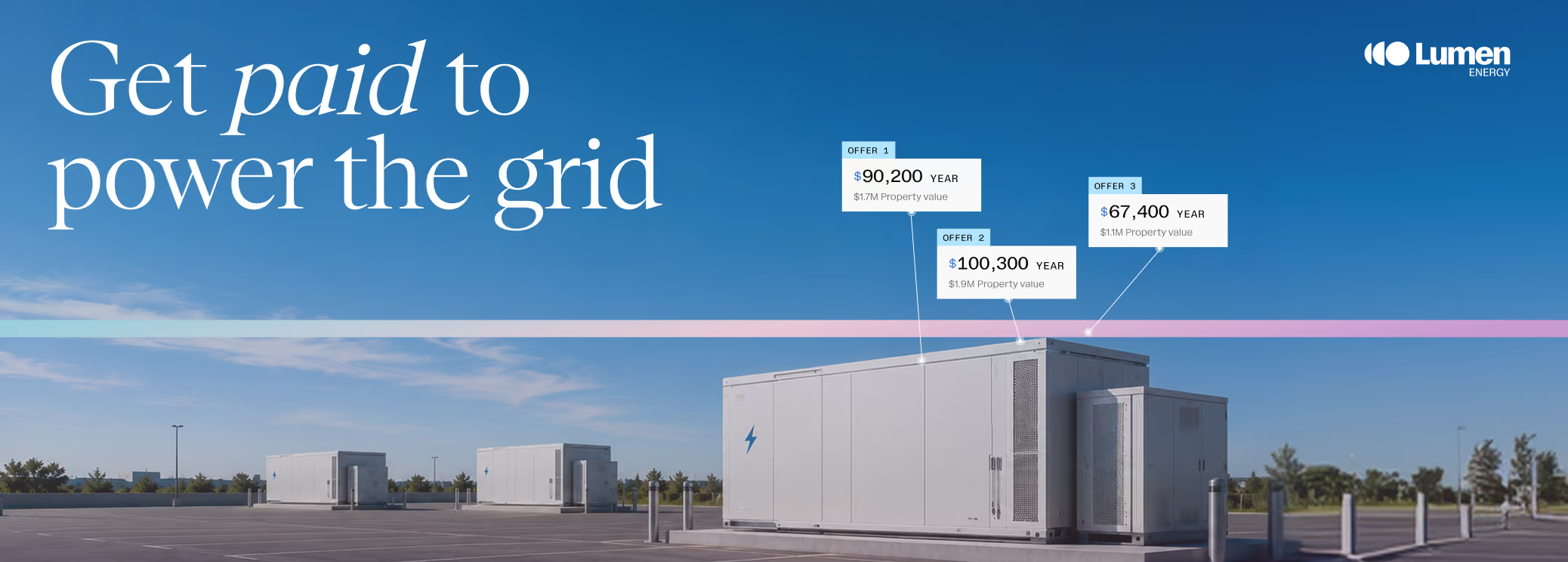
If you own commercial or industrial property in ComEd territory, an underused corner of your land may be one of the most valuable assets on your balance sheet right now. Here's what's happening, what it pays, and how to find out whether your sites qualify.
If you've ever leased a rooftop for solar, you already understand the shape of this deal. A developer pays you for space you weren't otherwise monetizing, builds and operates the system at their own cost, and hands you a long-term stream of rent. The battery version is the same concept — a ground lease instead of a roof lease — with one difference that tends to get people's attention: it pays as much as 10x more per square foot. A rooftop solar lease typically runs from $0.30-$1.25 per square foot per year. A battery ground lease in ComEd territory is running $6–7.
For a 10,000–15,000 square foot corner of excess land, that works out to roughly $60,000 to $105,000 a year, escalating 2% annually, on a 25-year lease. For a typical 5 MW site, that's more than $3 million in rent over the term — for land you probably aren't using today.
This post is meant to give you the full picture:
- What front-of-the-meter battery storage actually is
- What the economics look like, why northern Illinois specifically
- Whether it's safe
- What it looks like once it's built
- How to find out if your portfolio qualifies.
What a battery ground lease actually is
Front-of-the-meter (FTM) battery storage is, at its simplest, big batteries with a small footprint. Picture one or two rows of weatherproof cabinets about eight feet tall — the profile of shipping containers — sitting on a concrete pad inside a fenced and screened utility area occupying a 10,000–15,000 square foot corner of your property.
Those batteries make money by buying and selling power for the grid. They charge when electricity is cheap and discharge when the grid needs it most. The developer earns the grid revenue and pays you rent for the land underneath.
Crucially, all of that is somebody else's job. A professional developer designs, permits, builds, finances, insures, and operates the system entirely at their own cost for 25+ years. You lease the land and collect rent.
What you'd earn — and what it costs you
The headline terms, based on current ComEd-market developer offers, are $6–7 per square foot per year, or roughly $60,000–$105,000 annually for 10,000–15,000 square feet, escalating 2% each year over a 25-year term. Final terms are set per site through competitive bidding, but that's the range the market is supporting today.
Your cost in all of this is $0. The developer funds construction, insurance, operations, taxes on the system, and full removal at the end of the term — and covers any property-tax increase the system itself causes. You keep ownership of the land the entire time, and at the end of the lease the developer removes everything and restores the site. The 2% annual rent increase is contractually fixed, so you know exactly what the stream looks like for 25 years.
Why now, and why ComEd?
A few things have converged to make northern Illinois the most active battery market in the country right now. New 2026 Illinois energy-storage incentives lifts the lease rates developer can offer. Electricity demand is rising, which makes grid-serving batteries more valuable and good sites more sought-after. Standalone storage is eligible for a federal investment tax credit, which lowers project cost. And ComEd's interconnection capacity — with its mapped grid data — makes it easier to find sites that will actually work.
You don't manage any of those drivers. But together they're why developers are competing for good sites today, and why early movers tend to get the best prices.
Is it safe?
This is usually the first real question a property owner asks, and it's a fair one. The short answer is that battery energy storage is among the most thoroughly tested and code-governed energy infrastructure being deployed.
More than 1,000 battery projects operate across the US as of June 2026 — 185 of them came online in 2025 alone. These are proven systems at scale, not experiments. Global carriers including Munich Re, Swiss Re, Allianz, and AXA underwrite battery storage, and they require UL 9540 certification and documented fire-safety testing before they'll bind coverage. Since the developer owns, operates, and insures the system, that scrutiny is on them, not you.
On the regulatory side, projects are permitted under fire code NFPA 855, which governs siting, spacing, detection, suppression, and emergency response. UL 9540A large-scale fire testing is required evidence in permitting, and the local fire authority reviews and signs off before the system is allowed to operate.
Sources: SEIA BESS Safety Factsheet (Apr 2026); EPRI BESS Failure Incident Database; Cleanview US project tracker (Jun 2026); Fire & Risk Alliance for American Clean Power; NFPA 855 (2026 ed.); UL 9540 / 9540A.
What it looks like on your property
Owners are often surprised by how unobtrusive a finished site is. The cabinets are low-profile — about eight feet tall, roughly the height and footprint of shipping containers. They're quiet, producing a low hum comparable to commercial HVAC at the fence line. There are no emissions, no traffic, and no staff on site; the system is monitored remotely, around the clock.
The area is fenced, landscaped, set back from sensitive areas, and built on a concrete pad. And it's fully removable: at the end of the lease the developer takes everything out and restores the site. Site-specific renderings are provided during qualification, so you see exactly what it would look like on your parcel before committing to anything.
Will your site qualify?
Developers look for six things. You don't need to work through these yourself — this is exactly what a site screen checks — but it's useful to know what makes a strong candidate:
- ComEd service territory. Northern Illinois is the strongest storage market in the country right now.
- 10,000+ square feet of excess space. Underused land, yard, or low-value parking. Industrial and commercial sites are ideal.
- You control the land. Owned outright or held on a long-term ground lease; a 25-year lease needs clean title.
- Distance from neighbors. Roughly 150+ feet from homes, schools, and hospitals and at least 50 feet from all property lines or edge of public road right-of-way (or per municipal ordinance).
- Buildable area. Outside wetlands and floodplains, with road access for construction.
- Grid capacity nearby. This is the make-or-break factor, and it's screened against ComEd's grid data.
Industrial and commercial properties with excess land across ComEd's service area — Chicago metro, the Naperville corridor, Elgin, Aurora, Joliet, Rockford, Pontiac, Bolingbrook — are where the strongest opportunities are today.
How the process works, and when you get paid
The path from "let's take a look" to first rent check runs through five stages:
- Free screen — your portfolio is screened for potential sites, at no cost and no commitment. (1–2 weeks)
- Competitive bids — vetted developers compete for the opportunity to lease your sites. (~4 weeks to award)
- LOI and lease — you sign with the winning developer. (~2–3 months)
- Permits and grid — the developer completes interconnection and permitting. (6–12 months)
- Build and switch on — construction finishes, and rent payments begin. (4–6 months)
Full buildout takes one to two-plus years, because permitting and grid interconnection take time. The important part: you're paid during that stretch, not just after it. For an illustrative 5 MW site, that looks like a roughly $10,000 non-refundable option payment in the first 180 days after signing, another ~$10,000 in the next 180 days, and then roughly $100,000 a year in annual rent once the system goes live. Those option payments are yours to keep even if a project is never built.
Why run it through Lumen
Here's the part that matters most for the size of your check: Lumen isn't a battery developer. We run a competitive bid across vetted developers, because the spread between the lowest and highest offer on a given site can be as much as 4.3x. Leaving that on the table is the single most expensive mistake a property owner can make here.
On every Lumen site, 5+ vetted developers bid. We pre-screen ComEd grid capacity for you up front, so you're not chasing sites that can't interconnect. You review the bids, choose your sites, and keep 100% of the lease. You pay nothing — Lumen is paid by the winning developer, and only if a project is actually built.
Let's find out what your land is worth
It takes three steps, and they are all free to you:
- Share your property list. Addresses are all we need to get started.
- We screen it — free. Land fit, grid capacity, and a market check. No commitment, no cost.
- Review real offers. Pick your sites and see competitive developer bids within weeks.
To get started, contact a Lumen advisor at advisor@lumen.energy or visit lumen.energy