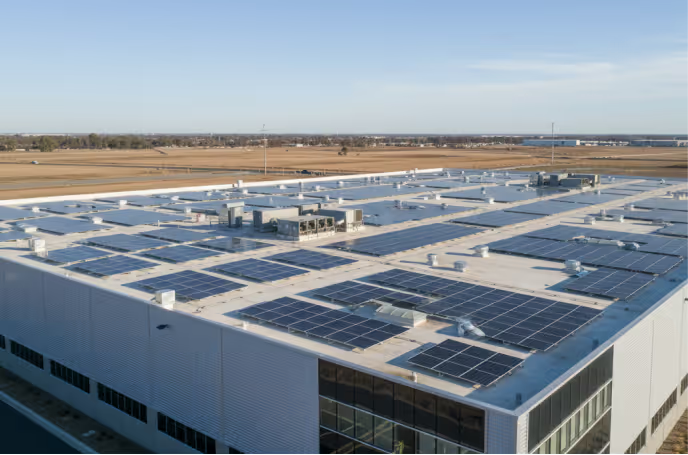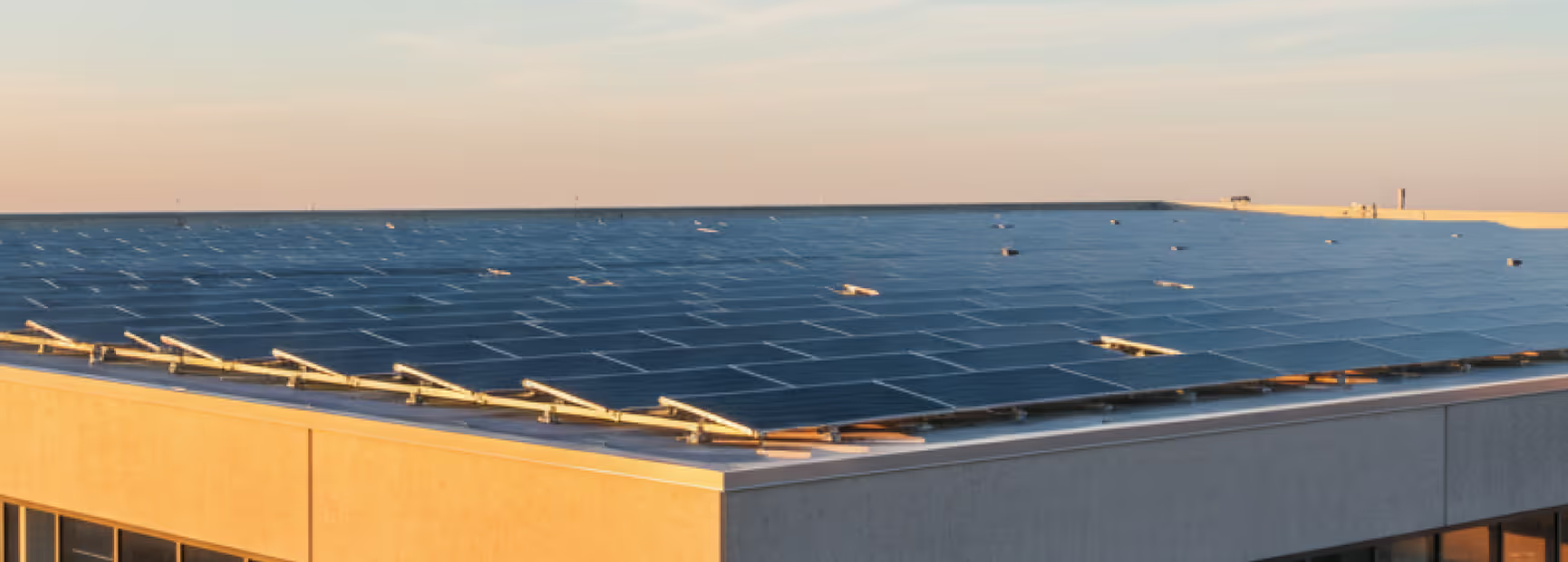
If you're a commercial real estate owner considering rooftop solar, one of the first questions that comes up is: Do I need to involve my tenants? The short answer: it depends on your lease structure and project type. The good answer: with the right approach, tenant communication can be straightforward—and in many cases, you can move forward without extensive tenant involvement at all.
Here's what asset management teams need to know about navigating tenant relationships during solar deployment.
Understanding your lease structure: the foundation of your approach
Your lease agreements determine how much—or how little—you need to involve tenants in rooftop solar decisions.
Triple Net (NNN) Leases
In NNN lease structures, tenants typically control building operations, but leases are often silent to explicit roof rights . This means:
- You'll want to proactively communicate with your tenant, even if explicit tenant approval is not required to proceed with rooftop installations
- Tenants may have concerns about roof warranties, structural load, or operational disruption
- The conversation should focus on tenant benefits: potential energy cost reductions through subscription to the project, sustainability credentials, and zero disruption to their operations
Gross and Modified Gross Leases
When you retain control of the building envelope and utilities under a gross lease:
- You can typically move forward without tenant approval for rooftop projects
- Tenant notification is still a best practice for relationship management
- Focus communication on the investment you're making in the property and long-term building resilience
Rooftop leasing vs. behind-the-meter solar: what tenants need to know
The type of solar project you're pursuing shapes the tenant conversation significantly.
Rooftop Leasing (Community Solar)
With rooftop leasing, you're renting roof space to a solar developer as part of a community solar program. For tenants, this means:
- Zero impact on their operations or energy bills (unless they separately opt into community solar subscriptions)
- No changes to existing utility service or infrastructure
- Minimal disruption during installation
This is often the simplest conversation: you're generating new revenue from underutilized space, and tenants experience virtually no change. Many owners successfully complete rooftop leasing projects with simple notification rather than extensive engagement.
Behind-the-Meter (BTM) Solar
Behind-the-meter solar generates power for on-site consumption, which directly affects tenant energy:
- Tenants on NNN leases should see reduced utility costs—a significant benefit
- You'll need to address how savings flow through (e.g., billing tenants for the solar energy through a green lease provision )
- This requires more detailed communication and potentially lease amendments
The value proposition is can be strong, but so is the need for tenant buy-in and coordination.
The strategic communication framework
Whether you're required to get tenant approval or simply want to maintain strong relationships, here's how to structure the conversation.
1. Lead with Alignment, Not Permission
Frame solar deployment as aligned with broader market expectations:
- "As part of our portfolio's sustainability strategy..."
- "To meet our fund's decarbonization goals profitably..."
- "In response to increasing ESG reporting requirements..."
This positions solar as a strategic portfolio decision, not a favor you're asking.
2. Address the WIIFM (What's In It For Me)
Tenants care about:
- Operational continuity: Assure them there will be no disruption to their business
- Cost implications: For BTM solar, quantify potential savings; for rooftop leasing, clarify zero impact
- Sustainability goals: Many corporate tenants have their own ESG commitments—solar helps them achieve Scope 2 emissions reductions
- Building resilience: Solar can potentially be paired with battery storage for backup power (if applicable)
3. Provide Investment-Grade Clarity
Tenants respect data-driven decisions. Share:
- Property-specific financial models showing the economic rationale
- Technical details about installation timeline, roof access needs, and safety protocols
- Information about the vetted solar developer you've selected through your competitive bid process
- Roof warranty and insurance coverage details
This demonstrates you've done rigorous due diligence, not made a hasty decision.
4. Emphasize Your White-Glove Approach
When you're working with Lumen Energy as your modern solar broker, you're not handing tenants off to a developer. You're managing the entire process with expert guidance, protecting their interests and yours throughout. Make this clear:
- "We've partnered with Lumen Energy, who sits on our side of the table throughout this process"
- "Our solar advisor will coordinate all aspects of installation to minimize any disruption"
- "We've secured competitive bids from top developers and selected the best fit for this property"
When you can (and should) move forward without extensive tenant involvement
In these scenarios, you can typically proceed with minimal tenant engagement:
You Retain Roof Rights Under Your Lease
If your lease clearly grants you control of the roof and building systems, you have the authority to move forward. A brief notification letter is professional courtesy, not a legal requirement.
You're Pursuing Rooftop Leasing with Zero Tenant Impact
When tenants won't see any operational changes, utility modifications, or cost implications, detailed engagement isn't necessary. Many owners send a simple announcement:
"We're pleased to inform you that [Property Name] will be participating in a community solar program. We'll be leasing a portion of the rooftop to a solar developer, generating new revenue for the property with zero impact to your operations or utilities. Installation is scheduled for [timeframe] and will not disrupt building access or services."
You're Working Through Portfolio-Level Strategy
For institutional owners deploying solar across dozens or hundreds of properties, individual tenant negotiations aren't scalable. In these cases:
- Focus tenant communication on properties where lease structure requires it
- Develop template notification language for other properties
- Use your Lumen Energy advisor to create a streamlined communication protocol that scales across your portfolio
Red flags that require deeper tenant engagement
Conversely, you should invest more time in tenant communication when:
- Tenants have roof access rights for their own equipment (HVAC, signage, telecom)
- You're proposing BTM solar that will change their utility billing
- The property is anchored by a major tenant who views the building as part of their brand
In these situations, early conversation prevents late-stage complications.
Timing your communication
The ideal timeline for tenant communication:
- During initial feasibility (optional): If you want to gauge tenant interest, especially for BTM solar with potential savings
- After securing your bid package (recommended): Once you have concrete project details, timelines, and developer information from your Lumen bid process
- 60-90 days before installation (minimum): Gives tenants time to review and ask questions without delaying your project schedule
- During installation (ongoing): Brief updates on progress and any temporary impacts (roof access, parking, etc.)
Avoid communicating too early—vague plans create more questions than answers. Wait until you have investment-grade financial analysis and a clear execution plan.
Sample communication templates
For Rooftop Leasing (Minimal Impact)
Subject: Solar Installation Notice – [Property Name]
Dear [Tenant],
As part of our ongoing commitment to building performance and sustainability, [Property Name] will be participating in a community solar program beginning [Month, Year].
We'll be leasing a portion of the rooftop to [Developer Name], a leading national solar developer, to install and operate a solar array. This project will:
- Support our portfolio's sustainability goals
- Have zero impact on your utilities, operations, or energy costs
Installation is scheduled for [timeframe]. We'll provide advance notice of any temporary roof access needs. Your business operations will not be affected.
If you have questions, please contact [Your Project Manager] at [contact info].
For BTM Solar (Direct Tenant Benefit)
Subject: Solar Project Proposal – Energy Cost Savings Opportunity
Dear [Tenant],
We're exploring an opportunity to install behind-the-meter solar at [Property Name] that could reduce your energy costs by approximately [X]% annually.
Here's what this means for you:
- Lower utility bills through on-site solar generation
- Increased building resilience and sustainability
- Support for your company's Scope 2 emissions reduction goals
- No upfront cost or operational changes required from you
We've completed investment-grade financial analysis with Lumen Energy, our solar advisor. We'd like to schedule a brief call to walk you through the potential for this project and answer any questions.
Please let us know your availability in the next two weeks.
Common tenant questions (and how to answer them)
"Will this affect my roof warranty?"
The solar developer will coordinate with existing warranty providers. We've reviewed this carefully with our advisors to ensure full coverage.
"What if I need roof access for my own equipment?"
We'll work with you and the developer to maintain access paths and accommodate any future equipment needs. This is addressed in our lease agreement.
"How long will installation take, and will it disrupt my business?"
Installation typically takes [X weeks]. All work happens on the roof, with no impact to your interior operations. We'll coordinate equipment staging to minimize any parking or access impacts.
"Can I opt out or object?"
[If you retain rights]: Under our lease agreement, we retain roof rights for capital improvements like this. However, we're committed to addressing any specific concerns you have.
[If tenant has rights]: Your input is important to us. Let's schedule a call to discuss your concerns and explore solutions.
"What happens when my lease ends?"
The solar installation is a building improvement that will remain in place. If you renew, you'll continue receiving any benefits. If you don't renew, the next tenant will benefit from the same energy savings/sustainability features.
The bottom line
Tenant communication doesn't have to be a barrier to solar deployment. With clear lease analysis, thoughtful timing, and a structured communication approach, you can move forward efficiently—sometimes without tenant involvement at all.
The key is understanding where your lease agreements grant you authority and where you need collaboration. When you're working with Lumen Energy, your solar advisor helps you navigate these nuances, draft appropriate communications, and address tenant questions with expert guidance.
Turn your rooftops into revenue while maintaining strong tenant relationships. It's not an either/or proposition—it's a strategic approach to portfolio management that serves everyone's interests.
Ready to explore solar for your portfolio?
Lumen Energy is the modern solar broker for leading commercial real estate owners. We provide investment-grade analysis, competitive developer bidding, and white-glove service throughout your solar deployment—including expert guidance on tenant communication.
Schedule a portfolio review to see which properties are ready for rooftop leasing and what your predictable revenue streams could look like.
Schedule your portfolio review
About Lumen Energy
Lumen Energy is the modern solar broker, partnering with leading real estate owners to turn their rooftops into new revenue. We deliver rigorous portfolio analysis, create transparent competition among top developers, and provide white-glove service throughout. Our efficient, technology-backed approach gives owners clarity, confidence, and reliable returns—scaling clean energy without added complexity.