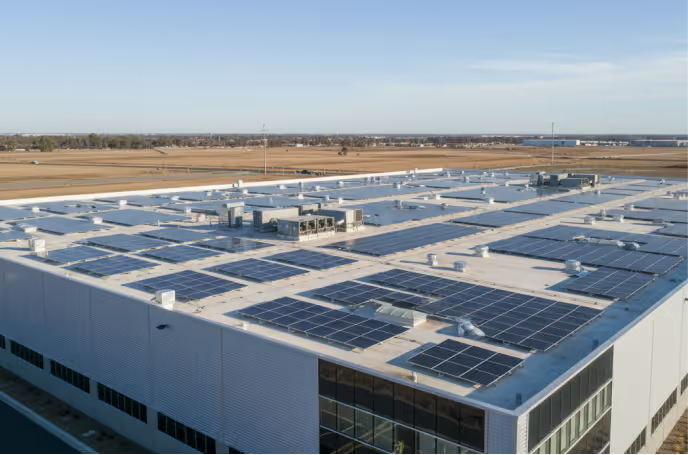
When commercial real estate owners solicit bids for onsite solar, one of the first surprises is how widely pricing can vary for the same building.
Across hundreds of transactions, we consistently see developers submit offers that differ by multiples, not margins. In one recent Maryland example, annual lease proposals ranged from $180,000 to $284,000. That $104,000 gap in year one alone adds up to more than $2 million over the life of the lease.
The takeaway is simple: a single developer quote is one opinion, but a competitive process is what reveals the true market value of solar on your building’s roof.
Why solar developer bids vary so dramatically
Each bid reflects a developer’s unique financial model, risk tolerance, and strategic priorities. Below is a summary of some of the factors underpinning the variation commonly seen in developer offers.
1. Cost of capital and return thresholds
Different developers operate with different financing structures and return requirements. For example, one developer may be willing to underwrite projects at an internal rate of return around 8 percent, while another may need 10 percent or more to satisfy investors.
Lower required returns allow a developer to offer higher lease payments or better PPA pricing.
2. Development and operating cost assumptions
Development costs vary widely across developers. A key differentiator is whether developers rely on third-party contractors or operate in-house Engineering, Procurement and Construction (EPC) teams. Outsourced EPC structures typically include contractor margins, added contingency, and schedule risk. Developers with internal EPC capabilities can consolidate development and construction costs, standardize designs, and source equipment at scale, which often translates into more competitive pricing.
Differences in operations and maintenance (O&M) cost assumptions also matter. Ongoing costs required to maintain solar assets over 20 years (or more) are modeled differently across developers, further widening bid spreads.
3. Tax credit assumptions
Federal Investment Tax Credits (ITC) can reduce project costs by 30% to 50%, but not every developer is able to capture the same level of benefit. In practice, the difference often comes down to whether a developer has the expertise and sourcing strategy needed to qualify for various bonus adders.
The two most common “optional” adders we see are:
- Domestic content, which requires meeting specific thresholds for U.S.-manufactured steel, iron, and other components
- Low-income community benefits, which can apply to certain projects serving qualifying census tracts or electricity subscriber populations
Some developers actively pursue these adders as part of their standard development process. They build their supply chain around qualifying equipment, and they structure deals to maximize eligibility. Others take a more conservative approach, either because they lack confidence in securing the adders or because they prefer to avoid compliance risk. In those cases, they underwrite projects assuming only the base 30% ITC.
For building owners, this difference in strategy matters because the ITC is often the largest single lever in a project’s economics. A developer pricing in a 40% or 50% tax credit can afford to offer meaningfully higher lease payments or more favorable PPA terms than a developer assuming only 30%, all other things equal.
4. Interconnection cost estimates
Interconnection costs are often the least certain part of a solar project’s economics. The cost to connect a system to the utility grid depends heavily on local grid capacity, feeder congestion, and the results of utility studies. In some cases, required upgrades are minimal. In others, they can exceed $1,000,000.
Because these costs are not known at the time of bidding, developers make different assumptions. Some underwrite projects with low interconnection budgets based on early screening or prior experience in the area. Others assume higher costs and include significant contingency to protect against downside risk.
These differing assumptions can materially affect pricing. A developer carrying aggressive interconnection assumptions may be able to offer a higher lease rate upfront, while a more conservative model produces a lower bid but with greater certainty of execution. Even before construction begins, interconnection alone can account for a large share of the spread between competing offers.
5. Contract term flexibility
Developers compete on more than just the headline lease rate. Seemingly small differences in contract structure can have a major impact on total value. A few common variations in terms that we often see include:
- Lease escalators (0% vs. 2% annual increases)
- Contract length (20 years vs. 25 years)
- Development rent (payments during permitting and construction)
- Roofing rights and responsibilities (access, repairs, and restoration obligations)
Two offers can look similar in year one but produce very different outcomes over time. For example, a 20-year lease with a 2% annual escalator may appear comparable to a 25-year lease with no escalator, but the net present value can differ by hundreds of thousands of dollars once cash flows, term length, and risk allocation are properly modeled.
6. Strategic market interests
Developers prioritize different markets and building types based on their growth strategy. A developer trying to establish a foothold in a new community solar market might stretch to offer premium rates to win early projects.
Conversely, developers already dominant in a market may bid more conservatively. In both cases, strategy, not just economics, influences the offer.
7. Power price projections
Developers must forecast future electricity prices over a long time horizon. Those projections directly shape expected project revenue and, in turn, how much a developer can afford to pay for a site.
More aggressive power price assumptions support higher lease payments but rely on prices rising as modeled. More conservative forecasts result in lower bids but reduce downside risk if prices flatten or decline. Ultimately, the difference between competing offers often reflects how much market risk a developer is willing to take, not just their view of the asset itself.
What this means for your portfolio strategy
Understanding bid variation is one thing. Capturing its value is another. To capture maximum value when procuring solar, Lumen recommends two core principles:
1. Run a competitive process
A structured, multi-developer bidding process creates transparency and forces bids onto a comparable playing field. It helps owners evaluate offers on consistent assumptions, screens out developers who lack the balance sheet or execution track record to deliver, and reveals true market pricing instead of a single data point.
In one recent example through Lumen’s marketplace, a competitive process across five properties attracted 86 bids from eight developers. Lumen revealed significant bid price variability, with some bids offering 2.5x higher returns versus others.
2. Think in terms of portfolio-wide value
On an individual building, bid variation might translate into tens of thousands of dollars in annual income. At a 5 to 7 percent cap rate, that can mean $1 million to $3 million in incremental value for a single asset.
Across a portfolio of 50 to 100 buildings, the impact compounds. The difference between sole-sourcing solar and running a competitive, portfolio-wide process can easily exceed $50 million in total portfolio value.
Real-world examples: What bid variation looks like
Maryland Industrial Portfolio: For 18 properties totaling ~10 MW, six developers submitted 96 unique bids. Annual lease income offers ranged from $400,000 to $720,000.
New Jersey Self-Storage: Three developers bid on a single property. Offers ranged from $26,640 to $80,000 annually - a 200%+ spread driven by different ITC strategies and interconnection assumptions, which Lumen then levelized for our client.
The bottom line: Treat solar like any other real estate decision
You wouldn't sole-source a $10 million roof replacement or accept the first offer on a property sale. Solar deserves the same rigor.
When you're evaluating onsite solar:
- Expect wide variation (2x to 5x) in developer pricing
- Understand the drivers: cost of capital, tax credits, interconnection, strategic interests, and term structure all matter
- Run a competitive process with at least 3–5 vetted developers bidding on standardized terms
- Balance rate with quality: the highest bid isn't always the most executable
- Think portfolio-wide: across dozens or hundreds of buildings, competitive bidding can unlock tens of millions in value
Lumen’s modern solar broker model exists precisely because of this pricing variation. Like a real estate broker helping you sell or lease properties, a solar broker ensures you're seeing true market value - not just what one developer is willing to offer.
Your rooftops are strategic assets. Make sure you're capturing their full value.
Ready to see what your portfolio could earn? Lumen Energy is the modern solar broker for commercial real estate owners. We deliver investment-grade analysis, create transparent competition among top developers, and provide white-glove service throughout - turning your rooftops into reliable revenue streams.