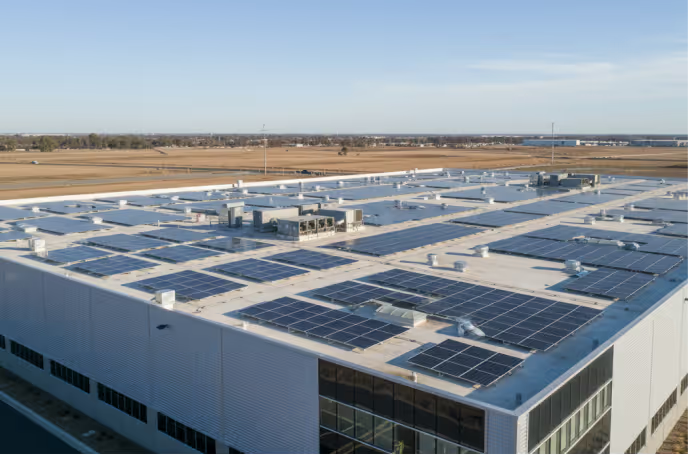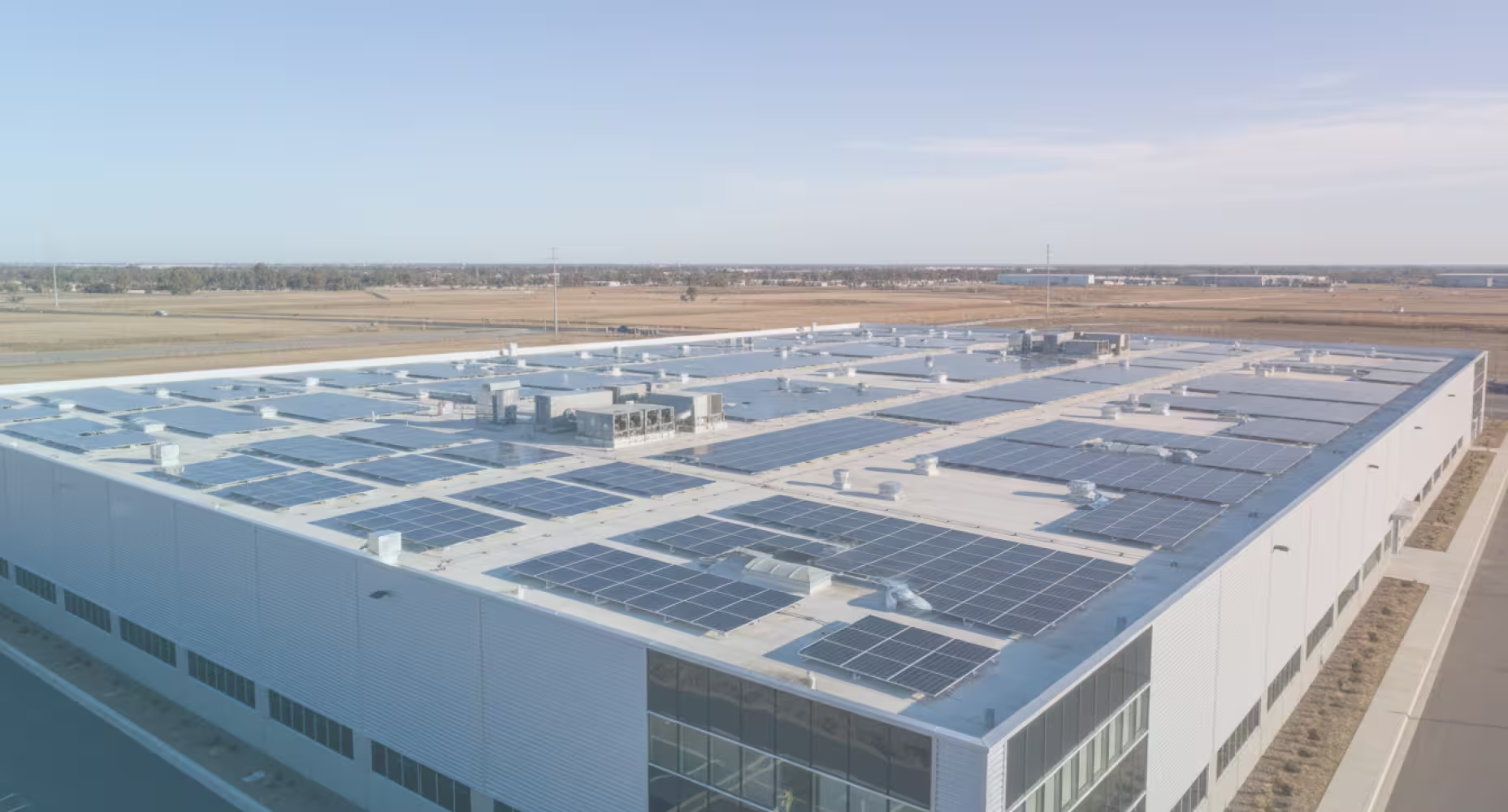
If you're managing a commercial or industrial property portfolio, you've likely heard that rooftop solar leasing can turn unused roof space into predictable revenue streams—with zero CapEx. But two critical questions remain: How much can your building actually earn? And how do you know if a lease offer is competitive?
Let's cut through the noise with data-backed answers that help you make confident decisions.
What is rooftop leasing?
Rooftop leasing is how commercial and industrial property owners access the benefits of community solar programs. Instead of installing solar to power your building directly, you lease your roof space to a solar developer who builds and operates a community solar system. The developer sells the clean energy to off-site subscribers—typically local residents and small businesses—and pays you fixed lease payments over 15–25 years.
The key advantage? No upfront capital expenditure, no ongoing maintenance responsibilities, and no requirement to involve your tenants. The solar developer handles everything. You simply add a new tenant to your roof—one that pays you reliably, year after year.
How much can your building earn?
Rooftop solar lease income varies based on several factors, but real market data gives us a clear picture of what to expect.
Typical lease payment ranges in the past
For large commercial and industrial buildings (100,000+ square feet) in strong community solar markets like Maryland, New Jersey, Illinois, and Massachusetts, annual lease payments typically fell in these ranges:
- Per-property basis: $70,000–$250,000+ per year
- Per-square-foot basis: $0.50–$2.00 per square foot of gross roof area per year
- Per-kilowatt basis: $40–$100 per kW of installed solar capacity per year
Real-world examples
The numbers become more tangible when you look at a few sample bid results:
- A 300,000 sq ft industrial building in New Jersey secured a roof lease offer of $429,000 per year—creating an estimated $6–8 million uplift in property value
- An office parking lot in Maryland secured a $180,000 annual lease for a 1.6 MW solar carport installation, adding new income and shaded parking for customers
- A portfolio of 13 industrial rooftops in Illinois unlocked $1.7 million annually in new lease income—or $34 million over 20 years
These aren't projections—they're real bids that are either already under contract or in contracting that will generate actual revenue for building owners.
What drives lease value?
Not all rooftops are created equal. Lease payments are determined by a bundle of factors:
- Building size and usable roof area – Larger roofs can fit more solar capacity, which translates directly to higher lease payments. Systems typically need to be at least 750 kW DC in size to be economically viable for most community solar programs.
- Location and state policy – Policies that enable solar developers to monetize clean energy vary significantly by state. Maryland, New Jersey, Massachusetts, and Illinois have robust Community Solar programs that enable competitive lease rates. Other geographies, like Washington D.C., Pennsylvania, Connecticut and parts of California also have viable leasing incentive structures. States and local utilities without such policies generally can't support rooftop leasing economics.
- Utility rates and local tariff structures – Higher grid electricity prices and, sometimes, favorable utility rate structures can increase the value developers are able to extract from the energy produced, which flows back to you as higher lease payments.
- Roof condition and remaining useful life – Roofs with 5+ years of remaining life are preferred. That said, roofs nearing replacement can still support attractive lease economics in today’s incentive environment. In some cases, pulling forward a roof replacement by 1-3 years to enable solar installation sooner can pay for itself in a year or less through uninterrupted solar lease revenue.
- Solar production potential – Most rooftops receive sufficient sunlight to support solar, but site-specific factors can affect system size and lease value. Shading from nearby buildings and roof designs that limit optimal panel orientation can reduce output and lower lease rates. All else equal, buildings in regions with fewer annual sunny hours may also generate lower lease values.
- Interconnection capacity and utility approval timelines – Access to local utility grid capacity and streamlined utility processes reduce developer risk and improve lease terms.
How do you know if a lease offer is a "good deal"?
A competitive lease offer isn't just about the headline number—it's about understanding market context, deal structure, and long-term alignment with your portfolio strategy.
1. Benchmark against market data
The simplest test: does your offer fall within the expected range for your building type and location?
- For Maryland, New Jersey, Illinois, and Massachusetts: industrial buildings over 100,000 sq ft historically see offers in the range of $70,000–$250,000+ annually, depending on size and roof suitability.
- Use $/kW or $/sq ft metrics to normalize offers across different project sizes. In the past lease rates of $40–$100/kW or $0.50–$2.00/sq ft of roof area are competitive benchmarks in strong markets.
- Be cautious of outlier offers that seem too good to be true—or too low. Both can signal developer inexperience, overly aggressive assumptions, or misalignment with market realities.
2. Understand lease escalators and payment structure
Most rooftop solar leases include annual escalators—typically 1–2.5%—to account for inflation and ensure your revenue grows over time. Look for:
- Fixed annual escalators (not contingent on energy production)
- Lease terms of 20–25 years (matching the developer's revenue timeline)
- Upfront clarity on payment schedules and any contingencies tied to regulatory approvals or interconnection milestones
3. Evaluate lease contingencies and risk allocation
Not all lease offers are apples-to-apples. Pay close attention to:
- Incentive dependencies: Some developers structure lease payments based on securing specific tax credits, renewable energy certificates (RECs), or bonus incentives (e.g., energy community or domestic content adders). Ask: what's the base-case payment if those incentives don't materialize?
- Roof replacement provisions – If your roof may need replacement during the lease term, ask if the lease includes a one-time roof replacement option with the developer covering panel removal and reinstallation. This is especially important for roofs with fewer than 20 years of remaining useful life, as replacement during the solar term can be costly.
- Lost energy revenue clauses: Developers will often include provisions that hold you responsible for lost revenue if the solar system must be shut down for a period (e.g., for roof repairs). Ask your advisor to quantify the exposure. In most cases, these costs are manageable and include annual grace periods before they take effect.
- Assignment and transfer rights: Can you sell the property with the new owner assuming the lease? Clear, bankable language here is essential for institutional portfolios.
4. Run a competitive bid process
Here's the single most important insight from analyzing hundreds of solar transactions: developer pricing varies dramatically—often by 2-5x—for the same building.
A lease offer from a single developer tells you one data point. A competitive bid process tells you the market value of your roof.
Running a transparent, multi-developer bid process through a solar broker like Lumen Energy ensures:
- You see at least three competitive bids with standardized terms for easy comparison
- Developers are pre-vetted for financial stability, technical capability, and track record
- Your interests are protected throughout negotiations—because we sit on your side of the table, not the developer's
In one recent example, a bid process for a single New Jersey building revealed lease offers ranging from ~$280,000 to $1,000,000 annually—a $720,000 difference in Year 1 alone, compounding to a ~$10 million difference in NPV across the lease term.
5. Align with your portfolio strategy
A "good deal" isn't just about the highest number. It's also about:
- Tenant and operational fit: Rooftop leasing avoids tenant involvement, making it ideal for multi-tenant and triple-net-lease buildings.
- Hold period alignment: If you're planning to sell the asset in 3–5 years, a 25-year solar lease needs clear assignment provisions and should enhance NOI to improve sale value.
- ESG and decarbonization goals: Hosting community solar strengthens your GRESB scores and can advance Scope 2 emissions reduction without operational complexity.
What if my building isn't in a strong community solar market?
If your portfolio is primarily in states without robust community solar programs—like Texas or Arizona—rooftop leasing economics may not work. In these markets, behind-the-meter solar through a Power Purchase Agreement (PPA) or direct ownership may be a better fit, particularly if you or your tenants pay high utility bills.
However, even one building in a competitive community solar state can unlock six-figure annual revenue. Portfolio-wide analysis ensures you don't miss those opportunities.
The bottom line: turn rooftops into revenue
For asset managers overseeing large industrial and commercial portfolios, rooftop solar leasing represents a rare combination: predictable cash flows, zero CapEx, and measurable ESG impact.
The key is knowing what your roof is worth—and ensuring you capture that value through competitive bidding and expert guidance.
Want to see what your buildings can earn? Lumen Energy provides investment-grade financial analysis at the portfolio level, runs transparent competitive bid processes, and delivers white-glove service from initial screening through signed lease agreements. We're the modern solar broker—and we sit on your side of the table.
Get started with a free portfolio assessment →
Frequently asked questions
Q: Do I need to replace my roof before leasing it to a solar developer?
Not necessarily. Roofs with 5+ years of remaining useful life are typically acceptable to developers. Many leases include provisions allowing you to replace the roof once during the lease term, with the developer covering solar decommissioning and reinstallation costs. In some cases, pulling forward a roof replacement by 1–3 years to install solar can pay back in under a year due to higher lease payments on a new roof.
Q: What happens if I sell the building during the solar lease term?
The lease transfers to the new owner as an encumbrance on the property—similar to a cell tower or billboard lease. A well-structured solar lease with strong payment terms can actually enhance building value by increasing NOI. Make sure your lease includes clear assignment provisions.
Q: Can my tenants subscribe to the solar energy produced on my roof?
Yes, in most community solar programs. This is optional and can provide your tenants with additional energy savings while you continue to receive your lease payments. It's a win-win for tenant relations and retention.
Q: How long does it take from signing a lease to receiving payments?
Timelines vary by developer, utility, and state. Typical projects take 12–24 months from lease execution to system operation and first payment. However, some leases include upfront or milestone-based payments during development.
Q: Are rooftop solar leases taxable income?
Yes, lease payments are generally taxable income. They can also increase your property's NOI, which can enhance asset value when you apply your cap rate. Consult your tax advisor for specific guidance based on your ownership structure.
The information on this blog is for general informational purposes only and does not constitute legal advice. Consult with a qualified attorney for advice specific to your situation.